
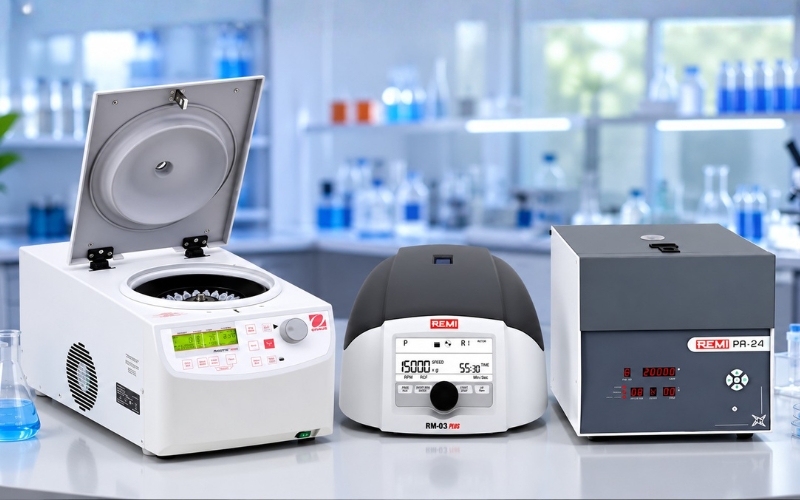
Laboratory centrifuges are among the most essential instruments used in research laboratories, hospitals, pharmaceutical companies, biotechnology facilities, diagnostic centers, and educational institutions. Whether you’re separating blood components, isolating DNA, preparing cell cultures, or processing chemical samples, selecting the right laboratory centrifuge directly impacts the accuracy, efficiency, and reliability of your results.
With numerous centrifuge models available in the market, choosing the right one can be challenging. Factors such as sample type, rotor compatibility, speed, capacity, temperature control, and safety features all play an important role in determining which centrifuge best suits your laboratory.
This guide explains everything you need to know before purchasing a laboratory centrifuge, helping you make an informed investment for your laboratory.
Why is a Laboratory Centrifuge Important?
A laboratory centrifuge separates substances of different densities by spinning samples at high speeds. The centrifugal force generated during rotation allows solid particles to settle while lighter components remain suspended.
Centrifuges are commonly used for:
- Blood sample separation
- Plasma and serum preparation
- DNA and RNA extraction
- Protein purification
- Cell harvesting
- Chemical analysis
- Pharmaceutical testing
- Clinical diagnostics
- Environmental research
Without a reliable centrifuge, many laboratory procedures would become slower, less accurate, and more labor-intensive.
Factors to Consider Before Buying a Laboratory Centrifuge
1. Understand Your Laboratory Application
Before selecting a centrifuge, identify how it will be used.
Ask yourself:
- Will you process blood samples?
- Do you perform microbiology research?
- Is molecular biology your primary application?
- Will the centrifuge be used for pharmaceutical testing?
- How many samples are processed daily?
Different applications require different centrifuge specifications.
For example:
| Application | Recommended Centrifuge |
|---|---|
| Clinical Laboratory | Benchtop Centrifuge |
| Blood Bank | Refrigerated Centrifuge |
| Biotechnology | High-Speed Centrifuge |
| Pharmaceutical Lab | Microprocessor-Controlled Centrifuge |
| Research Laboratory | Swing-Out Rotor Centrifuge |
2. Choose the Right Type of Centrifuge
Selecting the correct centrifuge type improves laboratory efficiency.
Benchtop Centrifuge
Suitable for routine laboratory work.
Ideal for:
- Hospitals
- Colleges
- Clinical laboratories
- Diagnostic centers
Benefits:
- Compact design
- Easy operation
- Affordable
- Low maintenance
High-Speed Centrifuge
Designed for advanced research requiring greater centrifugal force.
Suitable for:
- Molecular biology
- Protein analysis
- Cell separation
- Pharmaceutical laboratories
Benefits:
- Faster separation
- Greater efficiency
- High precision
Refrigerated Centrifuge
Some biological samples are temperature-sensitive.
A refrigerated centrifuge maintains a low operating temperature, protecting proteins, enzymes, DNA, RNA, and other biological samples from degradation.
Best suited for:
- Biotechnology laboratories
- Medical research
- Clinical diagnostics
- Pharmaceutical applications
3. Rotor Selection Matters
The rotor is the heart of any centrifuge.
Choosing the correct rotor depends on sample size and application.
Fixed-Angle Rotor
Best for:
- DNA extraction
- Protein separation
- Cell pellets
Advantages
- Faster sedimentation
- Higher speed
- Compact design
Swing-Out Rotor
Best for:
- Blood sample separation
- Plasma preparation
- Clinical diagnostics
Advantages
- Horizontal tube positioning
- Better sample layering
- Easy handling
4. Consider Maximum Speed (RPM)
Higher RPM does not always mean better performance.
Select the speed according to your laboratory application.
Typical recommendations:
- Routine testing: 3,000–5,000 RPM
- Blood separation: 4,000–6,000 RPM
- Molecular biology: 10,000+ RPM
- Advanced research: High-speed centrifuge
Always compare RCF (Relative Centrifugal Force) rather than RPM alone, as RCF provides a more accurate measure of separation capability.
5. Sample Capacity
Consider both your current and future laboratory workload.
Questions to ask:
- How many samples do you process each day?
- Will your workload increase?
- Do you require large-volume tubes?
Common capacities include:
- 6 × 15 ml
- 12 × 15 ml
- 24 × 15 ml
- 4 × 250 ml
- 6 × 1000 ml
Large research laboratories often benefit from high-capacity centrifuges that reduce processing time.
6. Temperature Control
Certain laboratory applications require temperature-controlled centrifugation.
A refrigerated centrifuge is essential when processing:
- DNA
- RNA
- Blood plasma
- Vaccines
- Protein samples
- Clinical specimens
Maintaining low temperatures improves sample integrity and ensures reliable research outcomes.
7. Safety Features
Modern laboratory centrifuges include advanced safety features that protect users and samples.
Look for:
- Automatic lid locking
- Imbalance detection
- Emergency lid release
- Over-speed protection
- Digital monitoring
- Automatic braking
- Motor protection
These features improve operator safety while extending equipment life.
8. Ease of Operation
Choose equipment with intuitive controls.
Features to consider:
- Digital display
- Programmable settings
- Memory functions
- Timer control
- Quiet operation
- Easy rotor replacement
User-friendly centrifuges reduce training time and improve laboratory productivity.
Why Choose a REMI Laboratory Centrifuge?
REMI centrifuges are widely trusted for their precision, durability, and advanced technology. They are suitable for research laboratories, hospitals, pharmaceutical companies, biotechnology facilities, and educational institutions.
Key benefits include:
- High-performance motors
- Digital microprocessor controls
- Swing-out and fixed-angle rotor options
- High sample capacity
- Reliable safety mechanisms
- Long operational life
- Easy maintenance
LabPrecise offers genuine REMI laboratory centrifuges with expert guidance to help laboratories select the right model for their applications.
Conclusion
Selecting the right laboratory centrifuge is a critical investment that directly affects research quality, laboratory efficiency, and sample integrity. Before making a purchase, evaluate your laboratory applications, sample volume, speed requirements, rotor type, temperature control, and safety features. A well-chosen centrifuge not only improves productivity but also ensures accurate and consistent results across a wide range of scientific and clinical applications.
Whether you operate a research laboratory, pharmaceutical company, hospital, or educational institution, investing in a reliable laboratory centrifuge can significantly enhance your workflow. At LabPrecise, you can explore genuine laboratory centrifuges from trusted brands like REMI, backed by expert support and dependable service to help you find the ideal solution for your laboratory needs.
What is the primary use of a laboratory centrifuge?
What is the primary use of a laboratory centrifuge?
A laboratory centrifuge is used to separate substances of different densities, such as blood components, cells, proteins, and DNA samples, using centrifugal force.
What is the difference between RPM and RCF?
What is the difference between RPM and RCF?
RPM measures rotational speed, while RCF measures the actual centrifugal force applied to the sample. RCF is a more accurate parameter for comparing centrifuge performance.
When should I choose a refrigerated centrifuge?
When should I choose a refrigerated centrifuge?
A refrigerated centrifuge is recommended for temperature-sensitive samples such as DNA, RNA, proteins, vaccines, and clinical specimens to maintain sample integrity.
Which rotor is better: fixed-angle or swing-out?
Which rotor is better: fixed-angle or swing-out?
Fixed-angle rotors are ideal for rapid sedimentation and molecular biology applications, while swing-out rotors are preferred for blood separation and clinical diagnostics.
What safety features should a laboratory centrifuge have?
What safety features should a laboratory centrifuge have?
Look for lid locking, imbalance detection, over-speed protection, digital monitoring, emergency lid release, and automatic braking for safe and reliable operation.
Where can I buy genuine laboratory centrifuges in India?
Where can I buy genuine laboratory centrifuges in India?
You can purchase genuine laboratory centrifuges from LabPrecise, which offers trusted brands such as REMI, along with expert guidance and after-sales support.