

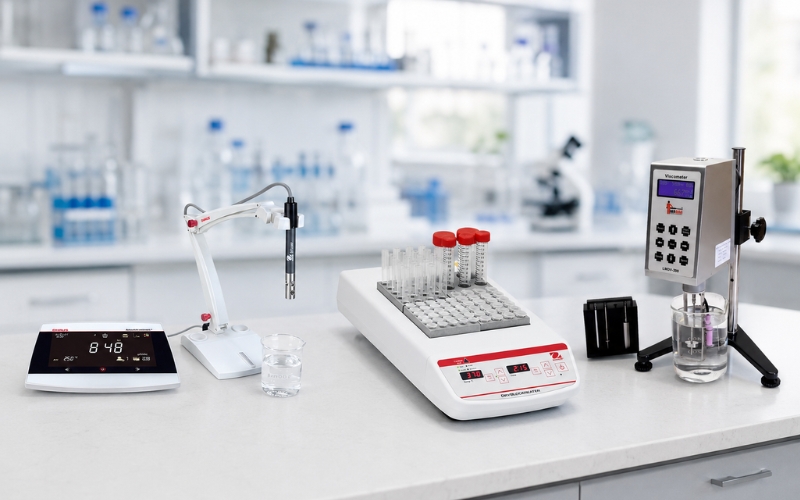
Choosing the right lab equipment is essential for maintaining accuracy, efficiency, safety, and consistency in laboratory operations. Whether you are setting up a new laboratory, upgrading an existing facility, replacing outdated equipment, or expanding your testing capabilities, selecting suitable laboratory equipment requires careful consideration of your applications and technical requirements.
Laboratories across pharmaceutical, healthcare, biotechnology, food and beverage, chemical, environmental, educational, and industrial sectors use different types of equipment for testing, research, analysis, measurement, and quality control. The right equipment depends on factors such as the type of testing, sample characteristics, required accuracy, operating conditions, laboratory workflow, budget, and long-term requirements.
This guide explains the key factors to consider when choosing laboratory equipment and selecting suitable solutions for your specific laboratory requirements.
What Is Lab Equipment?
Lab equipment refers to the tools, instruments, machines, and systems used in laboratories for research, testing, measurement, analysis, sample preparation, quality control, and other scientific applications. Laboratory equipment can range from basic products used for routine laboratory tasks to advanced scientific instruments designed for specialised analysis and research.
Common laboratory equipment categories include equipment for measurement, heating, cooling, mixing, sample preparation, sterilisation, analysis, testing, and environmental control. The specific equipment required depends on the laboratory’s purpose and the processes being performed.
Why Is Choosing the Right Laboratory Equipment Important?
Selecting appropriate laboratory equipment directly affects laboratory performance. Equipment that does not match the required application may result in inaccurate measurements, inefficient workflows, higher operating costs, and unnecessary maintenance requirements.
The right equipment can help laboratories:
- Improve measurement and testing accuracy
- Maintain consistent laboratory results
- Increase operational efficiency
- Reduce unnecessary downtime
- Improve laboratory workflow
- Support quality control procedures
- Meet application-specific requirements
- Improve safety and ease of operation
- Reduce long-term equipment costs
- Support research and development activities
For this reason, laboratories should evaluate their requirements carefully before purchasing or upgrading equipment.
1. Identify Your Laboratory Requirements
The first step in choosing the right lab equipment is to clearly identify what your laboratory needs to accomplish. Different laboratories perform different types of testing and analysis, so there is no single equipment solution suitable for every application.
Start by identifying:
- Type of testing required
- Samples or materials being tested
- Required measurement parameters
- Testing frequency
- Required accuracy and precision
- Laboratory environment
- Number of users
- Expected workload
- Available laboratory space
- Future testing requirements
For example, a pharmaceutical quality control laboratory may require different laboratory equipment than a food testing laboratory, a chemical laboratory, an educational institution, or a research facility.
2. Understand the Application
The intended application should be one of the most important factors when selecting laboratory equipment. Equipment specifications should match the testing procedure and the characteristics of the samples being analysed.
Consider whether the equipment will be used for:
- Research and development
- Quality control
- Sample preparation
- Material testing
- Chemical analysis
- Pharmaceutical testing
- Food testing
- Environmental analysis
- Educational applications
- Industrial testing
Understanding the application helps narrow down the available options and prevents investing in equipment with unnecessary features or inadequate capabilities.
3. Check Technical Specifications
Technical specifications allow you to determine whether a particular piece of laboratory equipment is suitable for your application.
Depending on the equipment type, important specifications may include:
- Measurement range
- Accuracy
- Precision
- Resolution
- Capacity
- Operating temperature
- Operating pressure
- Speed
- Sensitivity
- Power requirements
- Dimensions
- Material construction
- Environmental requirements
For advanced scientific instruments, specifications become even more important because small differences in performance can affect testing results and laboratory productivity.
Always compare the technical specifications with your actual laboratory requirements rather than selecting equipment based only on appearance, price, or brand familiarity.
4. Consider Accuracy and Precision
Accuracy and precision are critical when selecting laboratory equipment for testing and research. Equipment should provide performance appropriate for the type of measurement or analysis being performed.
If your laboratory performs sensitive testing, look for equipment designed to provide the required level of accuracy, repeatability, and measurement stability. The required performance level will vary depending on the application.
For example, routine laboratory work may have different accuracy requirements compared with advanced research, pharmaceutical quality control, or specialized analytical testing.
Laboratory equipment should be selected according to the expected workload. Purchasing equipment with insufficient capacity may create bottlenecks, while selecting equipment with significantly more capacity than required can increase the initial investment and operating costs.
Consider:
- Number of samples processed per day
- Batch size
- Testing frequency
- Number of users
- Required turnaround time
- Future laboratory expansion
If the laboratory is expected to grow, selecting equipment with suitable scalability can prevent the need for an immediate replacement.
Available laboratory space is another important factor when choosing lab equipment. Before purchasing equipment, check its dimensions and determine whether adequate space is available for installation, operation, maintenance, and ventilation.
Also consider:
- Electrical requirements
- Water connections
- Gas requirements
- Ventilation
- Temperature conditions
- Humidity requirements
- Clearance around the equipment
- Access for maintenance
- Transportation and installation requirements
Large or specialised scientific equipment may require specific installation conditions, so these requirements should be evaluated before placing an order.
Laboratory equipment should be practical and easy for trained laboratory personnel to operate. Complicated equipment can increase training requirements and may affect workflow efficiency.
When comparing products, consider:
- User interface
- Controls and displays
- Automation features
- Software compatibility
- Data recording
- Connectivity
- Cleaning requirements
- Maintenance procedures
- Training requirements
For laboratories with multiple users, an intuitive interface can make equipment easier to operate consistently.
Safety should never be overlooked when selecting laboratory equipment. Depending on the application, equipment may operate at high temperatures, pressures, speeds, or with chemicals and other potentially hazardous materials.
Review safety features such as:
- Automatic shut-off
- Over-temperature protection
- Alarms
- Safety interlocks
- Protective enclosures
- Emergency controls
- Leak detection
- Temperature and pressure monitoring
The equipment should also be appropriate for the laboratory’s operating environment and safety procedures.
Laboratory equipment is often used repeatedly for routine testing and research. Equipment quality and durability can therefore have a significant impact on long-term laboratory performance.
When comparing laboratory products, consider:
- Construction quality
- Materials used
- Expected operating life
- Reliability
- Maintenance requirements
- Availability of replacement parts
- Service support
- Warranty terms
Choosing equipment based solely on the lowest purchase price may not always result in the lowest total cost over its operating life.
Selecting the right lab equipment supplier is just as important as selecting the equipment itself. A reliable supplier can help you understand product specifications, compare suitable options, arrange equipment supply, and provide support when required.
Before choosing a supplier, consider:
- Product range
- Technical expertise
- Brand portfolio
- Product availability
- Warranty support
- Installation assistance
- After-sales service
- Spare parts availability
- Technical consultation
- Response time
- Industry experience
Working with an experienced laboratory equipment supplier can make the purchasing process easier and help reduce the risk of selecting unsuitable equipment.
Different manufacturers may offer laboratory equipment with different specifications, features, technologies, and price points. Instead of selecting a product based only on brand recognition, compare the equipment according to your actual application.
Create a comparison based on:
| Factor | What to Check |
|---|---|
| Application | Does it suit your testing requirement? |
| Accuracy | Does it provide the required performance? |
| Capacity | Is it suitable for your workload? |
| Specifications | Do the technical parameters match? |
| Operation | Is it practical for laboratory users? |
| Maintenance | Are servicing requirements manageable? |
| Support | Is technical assistance available? |
| Warranty | What coverage is provided? |
| Cost | Does it fit your budget and long-term requirements? |
This approach makes it easier to select equipment based on performance and value rather than price alone.
With the growth of digital procurement, laboratories can now explore and compare lab equipment online before making purchasing decisions. Online platforms make it easier to review product categories, technical specifications, applications, and available options.
When purchasing laboratory equipment online, always verify:
- Complete product specifications
- Product model and configuration
- Manufacturer or brand
- Warranty information
- Availability
- Delivery requirements
- Installation requirements
- Service support
- Pricing and quotation details
For specialized laboratory products, it is also useful to contact the supplier directly to confirm that the equipment is appropriate for your intended application.
The initial purchase price is only one part of the overall cost of laboratory equipment. Laboratories should also consider the long-term costs associated with operating and maintaining the equipment.
Total cost may include:
- Purchase price
- Installation
- Training
- Maintenance
- Calibration
- Consumables
- Replacement parts
- Energy consumption
- Software or accessories
- Service and repairs
A product with a higher initial price may provide better long-term value if it offers greater reliability, lower maintenance requirements, or improved productivity.
Your laboratory requirements may change over time. If you are planning to expand testing capabilities or increase sample volumes, consider whether the equipment can support future needs.
Ask:
- Can the equipment handle increased workload?
- Can additional accessories be added?
- Is software upgradeable?
- Can the equipment integrate with other laboratory systems?
- Are replacement parts likely to remain available?
- Can the equipment support future applications?
Planning ahead can help laboratories avoid frequent equipment replacement and unnecessary capital expenditure.
Before purchasing laboratory equipment, use the following checklist:
- Identify the laboratory application.
- Define the required testing parameters.
- Determine the required accuracy and precision.
- Check equipment capacity and workload.
- Review technical specifications.
- Confirm laboratory space and installation requirements.
- Evaluate safety features.
- Compare brands and product options.
- Consider maintenance and after-sales support.
- Compare total cost of ownership.
- Select a reliable laboratory equipment supplier.
- Confirm product suitability before purchasing.
Different industries require specialized laboratory equipment according to their testing and research activities.
Pharmaceutical Laboratories
Pharmaceutical laboratories use laboratory equipment for research, formulation, quality control, testing, and analytical applications. Equipment selection should align with the specific testing methods and quality requirements of the laboratory.
Food & Beverage Laboratories
Food testing laboratories use scientific equipment for quality, safety, composition, and analytical testing. Equipment should be selected according to the samples, testing procedures, and required analytical parameters.
Chemical Laboratories
Chemical laboratories require laboratory instruments and equipment for chemical analysis, research, testing, and quality control. Equipment should be compatible with the substances and testing conditions involved.
Research & Development Laboratories
Research laboratories often require specialized scientific instruments capable of supporting detailed measurements, experimentation, analysis, and data collection.
Educational Laboratories
Schools, colleges, and universities require laboratory equipment that is suitable for practical learning, demonstrations, experiments, and academic research.
Choosing a dependable lab equipment supplier can simplify the process of identifying and sourcing suitable laboratory products. LabPrecise provides a broad range of laboratory equipment, scientific instruments, and scientific equipment for research, testing, analysis, and quality control applications.
With products serving different industries and laboratory environments, LabPrecise helps customers explore equipment according to their application and technical requirements. From individual laboratory instruments to broader laboratory requirements, customers can discuss their needs and identify suitable equipment solutions.
If you are looking for lab equipment online, laboratory instruments, scientific equipment, or a reliable laboratory equipment supplier, LabPrecise provides a convenient platform to explore products and discuss your laboratory requirements.
Choosing the right lab equipment requires a balance between application requirements, technical specifications, performance, safety, capacity, reliability, and long-term operating costs. A well-planned equipment selection process can improve laboratory efficiency, support accurate testing, and reduce unnecessary replacement and maintenance expenses.
Whether you are setting up a new facility, expanding an existing laboratory, or replacing specific instruments, evaluate your requirements carefully and choose equipment that matches your current and future needs. Working with a reliable lab equipment supplier can further simplify the selection and procurement process.
Explore LabPrecise for laboratory equipment, scientific instruments, scientific equipment, and lab solutions designed for research, testing, quality control, and professional laboratory applications.
What should I consider when choosing lab equipment?
What should I consider when choosing lab equipment?
Consider the intended application, technical specifications, accuracy, capacity, laboratory space, safety requirements, ease of operation, maintenance, warranty, and after-sales support. Choosing equipment based on actual laboratory requirements helps ensure better performance and long-term value.
How do I choose a reliable lab equipment supplier?
How do I choose a reliable lab equipment supplier?
Look for a supplier with a suitable product range, technical expertise, reliable brands, product support, warranty coverage, service capabilities, and experience serving your type of laboratory. A supplier should also be able to provide relevant product information and assist with equipment selection.
Can I buy lab equipment online?
Can I buy lab equipment online?
Yes, many types of laboratory equipment and scientific instruments can be explored and purchased online. Before purchasing, verify the product specifications, configuration, warranty, availability, installation requirements, and supplier support.
What is the difference between laboratory equipment and scientific instruments?
What is the difference between laboratory equipment and scientific instruments?
Laboratory equipment is a broad term covering products used for laboratory operations, testing, preparation, measurement, and other processes. Scientific instruments generally refer to specialized devices used for measurement, analysis, observation, and scientific research. The two categories can overlap depending on the product and application.
How do I know which laboratory equipment is suitable for my application?
How do I know which laboratory equipment is suitable for my application?
Start by defining your testing method, sample type, required measurement parameters, accuracy, capacity, operating conditions, and workflow. You can then compare equipment specifications and consult a qualified laboratory equipment supplier for product recommendations.